
I Want to Work in Clean Energy

Updated: Mar 30
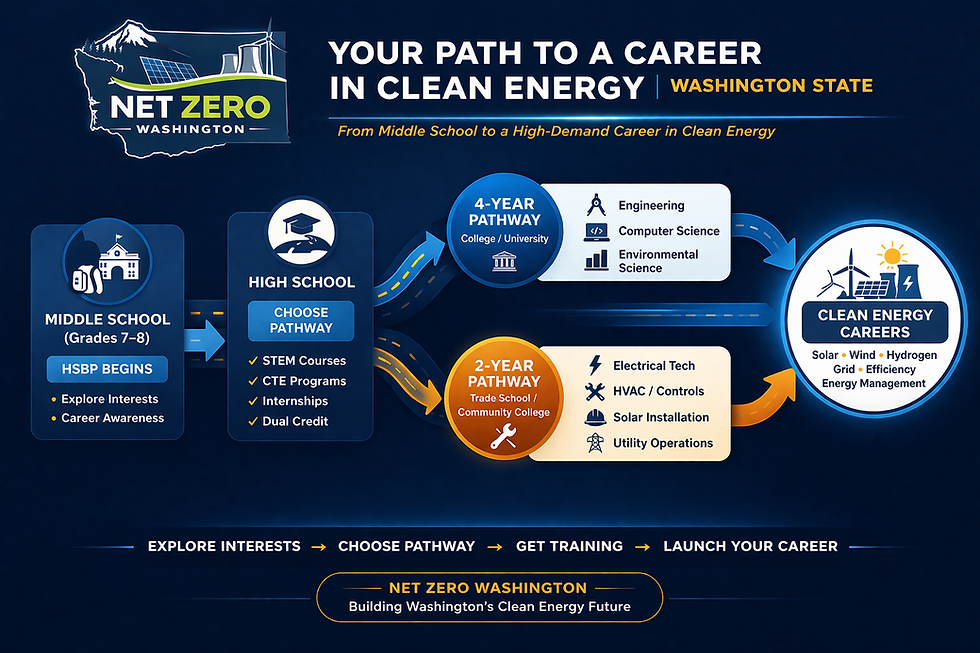
A note to students exploring career pathways in Washington State
When students tell me, “I want to work in clean energy,” they often go on to talk about solar panels or wind turbines or lobbying for change. Personally, when I thought about a career in clean energy, I pictured fancy trade shows and nice suits working in an office in Downtown Seattle.
But clean energy is much bigger than that.
Behind every solar project is an entire ecosystem of professionals—engineers, electricians, manufacturers, construction crews, environmental scientists, financial analysts, sales & marketing, and operations specialists.
A single solar project can involve hundreds of workers across dozens of professions.
If you're thinking about a career in clean energy, the question isn't whether or not there are jobs. The bigger question is what are you good at and passionate about?
If you’re in Washington, your High School and Beyond Plan (HSBP)—which starts in middle school—can help you begin aligning your classes with a future in clean energy and if you’ve found your way here, you’ve probably asked a simple question:
“How do I work in clean energy?”
Before we talk about the jobs, let me introduce myself.
On paper, I’m an economist & entrepreneur with a couple decades of experience working primarily on energy & aerospace projects and I've given advice to elected officials and billionaires at home and abroad. That sounds pretty serious and professional but, the truth is, in my heart I’m still just a curious kid always looking for the next big challenge.
I’ve always been the type who wanders off to talk to strangers, asks too many questions, takes things apart to see how they work, and dreams up ways to do it better.
That curiosity eventually turned into a career as a project manager, inventor, and entrepreneur. I used to think working in clean energy would involve fancy suits and a cool office but, most days, I show up to work wearing jeans and cowboy boots and typically work from home or out of my Jeep, and my job is less office work and more meeting with people while tromping around in the mud and the weeds figuring out how to turn big ideas about energy into real tangible projects.
And those projects involve a lot more careers than most people realize.
So let’s walk through a simple example: a solar project in Washington State.
A Solar Project Is Actually Hundreds of Jobs
When people think about solar energy, they picture panels on a roof or in a field but building that project requires professionals across many industries.
Some of those jobs require college degrees. Some require apprenticeships. Some start right out of high school.
Let’s look at the different stages.
Step 1: Designing and Planning the Project
Before a new home development with solar on the roofs or a large solar project in a field gets built, people have to figure out where a project should go and whether it makes sense.
Jobs in this stage include:
Civil engineers
Electrical engineers
Energy analysts
GIS mapping specialists
Environmental scientists
Wildlife biologists
Land development managers
Real estate specialists
Sales & marketing professionals
Survey crews
Project finance analysts
These professionals study everything from soil conditions to wildlife habitat to power grid capacity.
Step 2: Engineering the Energy System
Once the project is approved, engineers design how it will work.
This includes:
Power systems engineers
Structural engineers
Substation engineers
SCADA and controls engineers
CAD designers
Energy modeling analysts
Many of these engineers work for utilities, consulting firms, or independent energy developers.
Step 3: Building the Project
This is where the trades come in—and where many of the highest-demand jobs are today.
Depending on the size of the installation, a solar project construction site might include:
Heavy equipment operators
Ironworkers
Welders
Pile-driver operators
Journeyman electricians
Apprentice electricians
High-voltage technicians
Construction managers
Safety managers
Quality inspectors
Many of these careers, such as electricians, come through apprenticeship programs, where you earn while you learn.
Step 4: Connecting to the Electric Grid
Once the project is built, it must connect to the power system that serves homes and businesses.
Careers involved include:
Utility interconnection engineers
Relay technicians
Substation technicians
Electrical inspectors
Grid operations specialists
These roles are critical to keeping the electric grid safe and reliable.
Step 5: Operating the Facility
Solar facilities operate for 20–40 years, which means long-term technical jobs to maintain the solar systems installed now and in the future.
These include:
Electricians
Solar technicians
Field service technicians
Monitoring analysts
Compliance reporting analysts
Vegetation management crews
Asset managers
Performance engineers
Even a small project creates ongoing local jobs.
Career Pathways in Washington State
One of the great things about Washington is that the state has built strong career pathways into energy and infrastructure jobs.
Here are a few places to explore if you're interested.
CTE Skills Centers
The WA State Office of Superintendents of Public Instruction (OSPI) oversees some of the best CTE programs in the nation. Plug into the Skills Center nearest you and begin your career in clean energy while in high school.
Career Connect Washington
This statewide network connects students with real-world career exploration, internships, and training programs tied to Washington industries.
Pacific Northwest Center of Excellence for Clean Energy
This organization works with Washington’s community and technical colleges to help students train for high-wage energy careers and understand the skills employers need.
Washington Apprenticeships
Apprenticeships combine classroom instruction with paid on-the-job training and can lead to associate degrees in many trades.
Clean Energy Workforce Programs
These programs help students learn about careers in solar, HVAC, utilities, and energy efficiency.
Brian’s Forecast: The Jobs That Will Be Most in Demand
Federal program funding & grants come and go, however, Washington State has shown a pattern of sticking to their guns on environmental issues despite what is happening at the Federal level. If WA State continues on its current trajectory and enforces the Clean Energy Transformation Act (CETA) and the Climate Commitment Act (CCA), then we should see the State entering a period of major investment in energy infrastructure. Otherwise, the goals in the CETA and the CCA are unsustainable.
Over the coming decades, the State, utility companies & supporting businesses will need to:
expand renewable energy production
increase energy efficiency of existing homes & commercial buildings
upgrade transmission lines
modernize substations
electrify most transportation
modernize homes & offices to include EV charging stations
strengthen grid resiliency
introduce economically viable solutions for reducing CO2 emissions from industrial operations
That means strong demand for workers such as:
electricians
lineworkers
engineers
energy technicians
construction project managers
grid operators
The transition to clean electricity isn’t just about climate policy.
It’s about building the next generation of infrastructure.
And infrastructure improvement mean good paying jobs.
One Final Thought
If you’re trying to figure out what you want to do with your life, here’s some advice that has helped me.
Before trying to pin-down a career title, answer the following questions for yourself.
What kinds of problems in the world do you want to solve?
What lights you up?
What are you good at?
What are you interested in?
Where in the world do you want to work?
Do you want to work in the office or in the field?
What pays well and is in demand?
Not everyone will find a home in clean energy but I challenge the curious and the tinkerers out there to join find ways to do it better.


Comments