
What Does “Net Zero” Actually Mean?

And what it means for Washington State
“Net zero” is a phrase you’ll hear a lot in conversations about climate and energy.
Cities are setting net-zero goals.
Companies are committing to net zero.
States—including Washington—are building policies around it.
But what does net zero actually mean?
At its simplest, net zero means this:
The amount of greenhouse gases going into the atmosphere is balanced by the amount being removed.
In other words, the “net” impact on the climate is zero.
But getting there requires a major and costly transformation in how we produce energy, move goods and people, heat buildings, and run industries.
And that transformation is already underway here in Washington State.
Why Energy Matters So Much
Most greenhouse gas emissions come from how we produce and use energy.
The biggest sources include:
electricity generation
transportation
homes & commercial buildings (heating and cooling)
industry and manufacturing
This energy has traditionally come from fossil fuels like coal, oil, and natural gas.
Fossil fuels such as diesel, gasoline, jet fuel, and liquid natural gas are incredibly useful—but they do release carbon dioxide (CO2) when burned.
The goal of net zero is to reduce those emissions as much as possible and replace them with cleaner energy sources.
Washington Starts With an Advantage
Washington is already one of the cleanest electricity systems in the United States.
That’s because the state benefits from a huge amount of hydropower, which produces electricity without carbon emissions.
Roughly two-thirds of Washington’s electricity comes from hydroelectric dams on rivers like the Columbia, Snake, and Spokane. By capacity, Grand Coulee Dam is the largest single power plant in the nation US.
Other clean energy sources in Washington include:
wind power in Central and Eastern Washington
growing solar projects across the state
nuclear power at the Columbia Generating Station
energy efficiency improvements across the state
Because of this, Washington begins the energy transition with a strong foundation.
But reaching net zero still requires major changes.
Washington’s Clean Electricity Goals
In 2019, Washington passed the Clean Energy Transformation Act (CETA), one of the most ambitious electricity policies in the country.
CETA sets three major milestones.
By 2025
Washington law requires utilities to remove coal-fired electricity from their power supply by the end of 2025. The state’s last coal facility—the TransAlta Centralia Generating Station—was scheduled to shut down its remaining coal unit at that time.
However, in December 2025 the U.S. Department of Energy issued a temporary emergency order requiring the plant to remain available to operate due to concerns about regional grid reliability. The order has triggered legal challenges from Washington State and environmental groups.
Although the plant has stopped generating electricity from coal, the dispute highlights the complex balance between state climate policy, federal authority, and regional grid reliability.
By 2030
Electricity must be carbon-neutral, using renewable energy and other compliance tools.
By 2045
Washington’s electricity must be 100% clean, meaning it produces no greenhouse gas emissions. This means that all electricity used in the state must be generated from geothermal, hydro, solar, and wind.
These goals are driving major investments in energy infrastructure across the state.
Net Zero Means More Than Clean Electricity
Even though Washington already has incredibly clean electricity, power generation is only part of the net-zero equation, however, it can also be a solution or the solution for other sectors' challenges in reducing their greenhouse gas emissions.
WA State currently ranks #24 in in total CO2 emissions.
The CETA addresses CO2 emissions from power production while the Climate Commitment Act (CCA) addresses greenhouse gas emissions from all other sectors.

Transportation
Transportation is Washington’s largest source of greenhouse gas emissions at 44.5%.
Moving toward net zero will involve:
increasing the number of electric cars and trucks
electrifying public transit and improving it in general
producing cleaner fuels for planes, trains & ships
building communities strategically to require less driving
Homes & Buildings
Many homes and commercial buildings still rely on natural gas or fuel oil for heating and account for a combined total of 31.8% of all greenhouse gas emissions in the state.
Solutions include:
electric heat pumps
improved building efficiency
better insulation and building design
Industry
Some industries—like cement, steel, and heavy manufacturing—emit a lot of greenhouse gasses but are the hardest parts of society to decarbonize while staying economically competitive. Industrial operations account for 23.7% of the state's greenhouse gas emissions.
Researchers are exploring options such as:
renewable hydrogen
electrified industrial processes
carbon capture technologies
The Infrastructure Challenge
One of the biggest realities of the transition to net-zero is that living in a nearly all-electric society will require building a lot of new infrastructure.
That includes:
solar projects
battery storage systems
transmission lines
substations
electric vehicle charging stations at home and workplaces
Even though Washington already produces clean electricity, electricity demand is expected to grow significantly in the coming decades.
Why?
Because we’ll be using electricity for things that used to rely on fossil fuels—like cars, heating systems, and industrial equipment.
Meeting that demand will require more generation and a stronger grid.
The Role of the Electric Grid
The electric grid is the system that moves electricity from power plants to homes, businesses, and communities.
Much of the grid infrastructure we rely on today was built decades ago.
To support a clean energy future, utility companies will need to:
upgrade transmission lines
increase substations
modernize distribution systems
improve grid resilience against storms and wildfires
These upgrades will be essential to keeping electricity reliable, affordable, and secure.
Net Zero Is Also an Economic Opportunity
Sometimes the conversation about net zero focuses only on environmental impacts or political opinions.
But it is also about jobs, technology, and economic development.
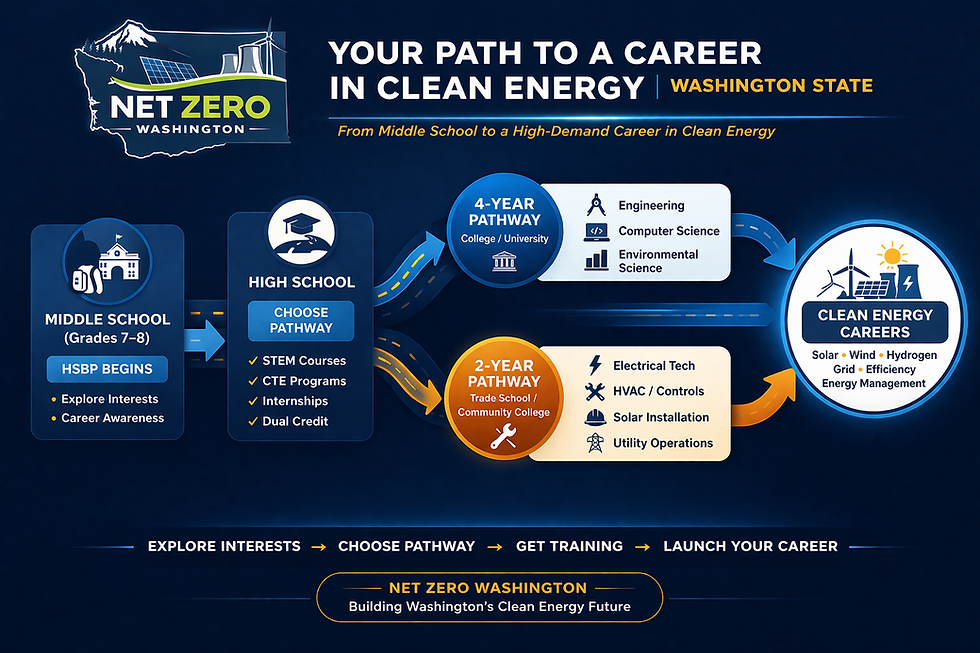
The energy transition will require workers in many fields:
electricians
engineers
construction trades
environmental scientists
data analysts
project managers
energy technicians
Building the next generation of energy infrastructure will create thousands of well-paying jobs across Washington.
The Path Forward
Net zero is not a single technology or policy.
It is a long-term transformation of the energy system that will require an all-of-the-above approach.
In Washington, that transition will involve:
expanding renewable energy
electrifying transportation and buildings
modernizing the electric grid
improving energy efficiency
supporting innovation in emerging technologies
None of this happens overnight.
But every solar project, wind turbine, transmission line, and efficiency upgrade moves the state closer to that goal.
Why This Website Exists
Net Zero Washington exists to help explain how that transition is happening.
Energy systems are complicated. Policies are complicated. Infrastructure is complicated.
But understanding them matters—because the decisions being made today will shape
Washington’s energy system for decades.
The goal here is simple:
To help people understand how the transition to clean energy actually works.
And how Washington can build an energy system that is clean, reliable, and resilient for the future.

Comments